
What Is a SUP Cat? Electric Paddle Board Catamaran!
SUP Cat Silent Electric Paddle Board!
I built the world's lightest, least expensive, most versatile and most efficient pontoon boat - the SUP Cat!
I honestly can't count the number of boats, canoes, and kayaks that I have owned in my lifetime. I have fished and hunted from boats for over 50 years across the U.S. and Canada. There was even a period of years when I was a "professional" tournament angler who bought and sold at least one boat per year...
I still own multiple kayaks and canoes. But I only own ONE "power boat" - and that is the SUP Cat!
My kayaks and canoes are all designed for only one paddler. Two of my kayaks can be pedaled and/or paddled. After owning dozens of power boats - from 15 to 250 horsepower - I now own a SUP Cat with a tiny 36-pound thrust electric motor.
What is a SUP Cat? What Makes the SUP Cat Different?
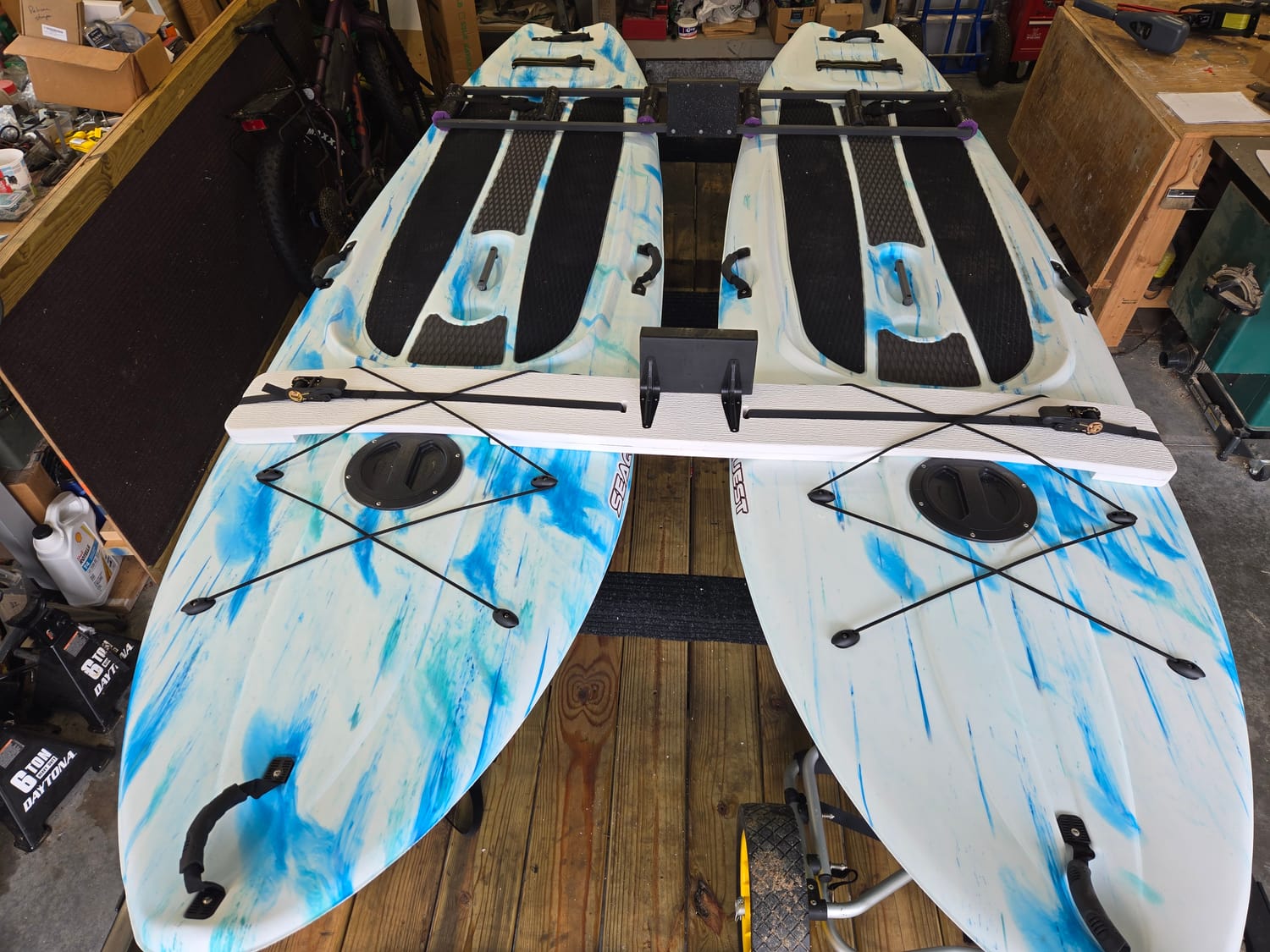
Building the SUP Cat from TWO Paddle Boards
The SUP Cat combines two paddle boards to form the catamaran or pontoon.
It is possible to combine two inflatable paddle boards - and this is the best option for storage and transport without a trailer.
In my case, I have a perfect trailer for transporting the SUP Cat. I also occasionally fish water with nasty, sharp rocks! For this reason, I chose to build my SUP Cat with two hard paddle boards.
The paddle boards are assembled into a catamaran with frames ahead of and behind the seats. I built a metal frame for the rear which is padded with foam noodles, then lashed in place with web straps.
But the front of my hard paddle boards had molded decks (and storage hatches) that interfered with the metal frames. So I built the front frame using PVC planks cut to fit the decks. As shown above, these planks are secured to the paddle boards with continuous ratchet straps - tightened just enough to slightly deform the hollow plastic paddle boards. The PVC boards are laminated from two layers, but are still flexible enough to conform to the PB decks.
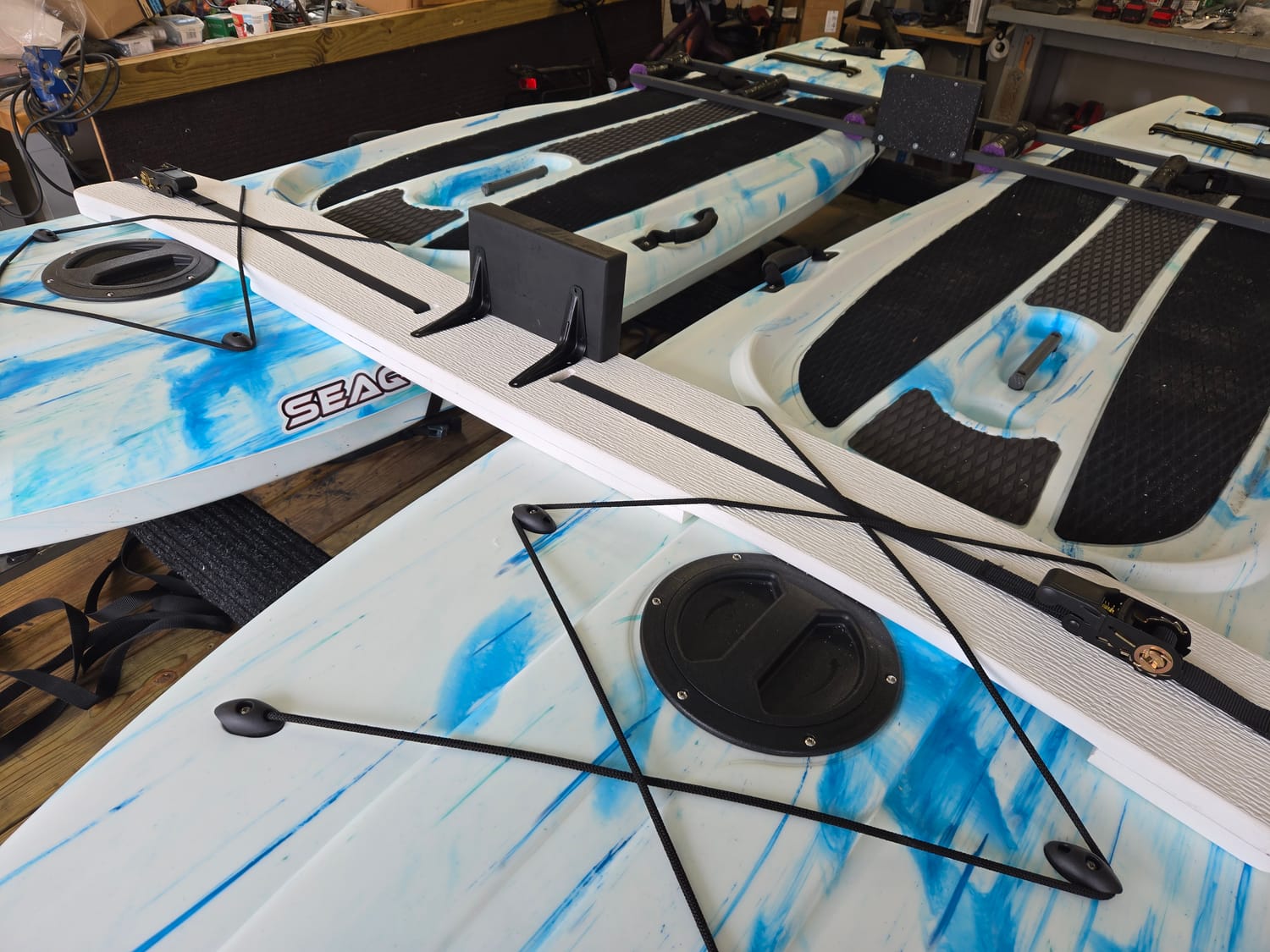
The Two PBs secured with ratchet straps around the flexible PVC planks
The front and rear frames hold the paddle boards apart to provide room for the trolling motor. My original plan was to mount the trolling motor on the front "bridge" - as shown above. But this would have necessitated a jointed extension handle on the motor and would have interfered with fishing rods. I quickly realized that a rear motor mount would have many advantages.
My completed SUP Cat now includes a motor mount on the rear "bridge", but with the motor at the front. This moves the motor forward for an easier reach and also moves the motor weight slightly forward for a better trim.
I added two comfortable, folding "Ascend" kayak seats that I found at Bass Pro Shops. Combined with a small electric motor, the SUP Cat is the world’s smallest – and most affordable – “pontoon boat”!
The catamaran concept makes the SUP Cat virtually untippable. The combined width is about 66-inches at midships. The flat paddle boards allow it to travel quietly and with perfect stability in shallow water. But the stability is also incredible in the wind and when encountering the wakes of motorboats.
It is easy to stand on the double paddle boards – for both fishing or paddling. All paddle boards have a non-slip deck designed for standing. But I sit almost 100% of the time and use the trolling motor.
The paddle boards are not altered in any way – so you could stand and use long paddles. Or you can kneel or sit to paddle - and I always carry a shorter paddle use around shore. You can also separate the PBs and use them individually, with paddles instead of the electric motor.
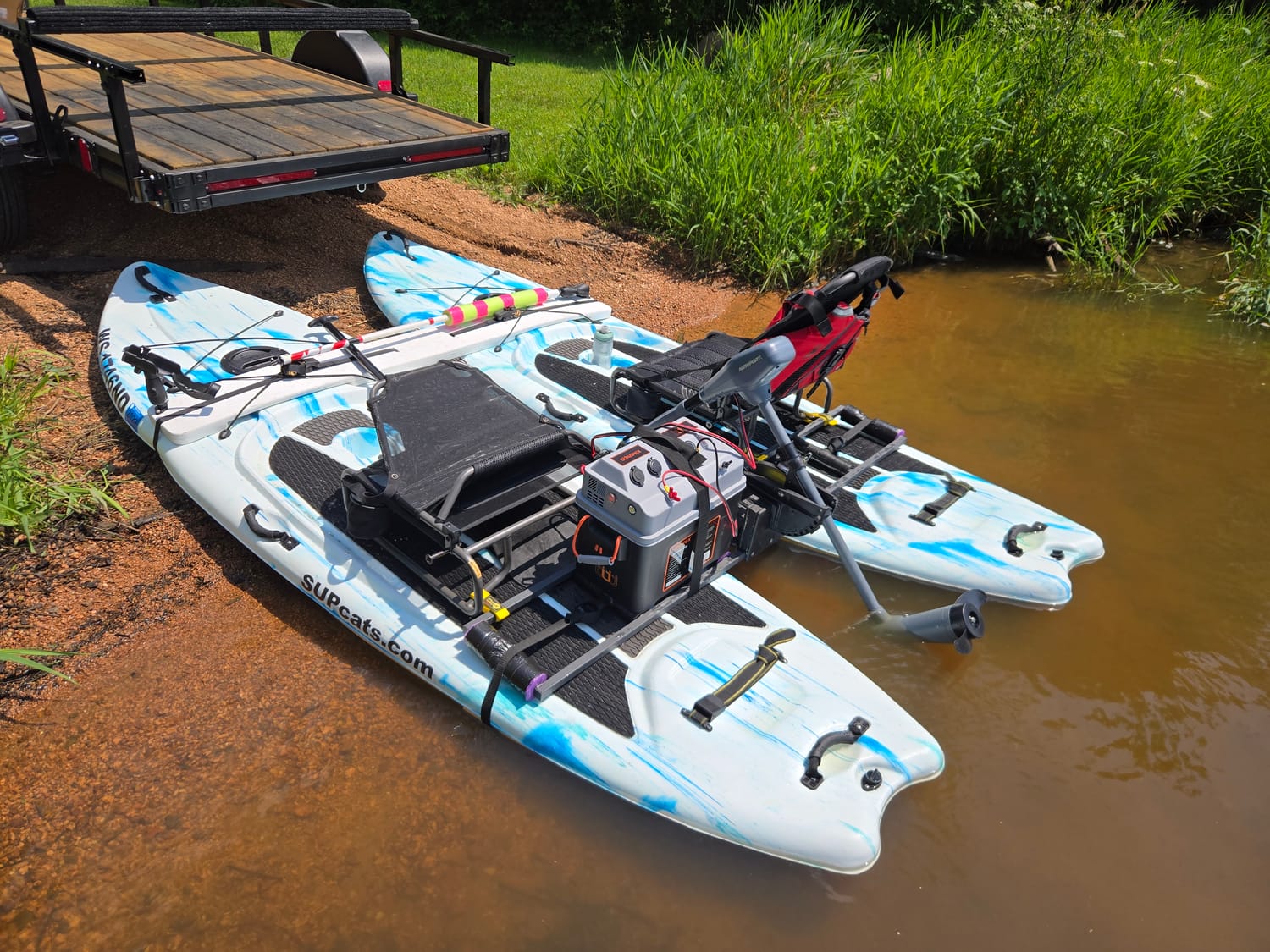
SUP Cat with electric motor and battery, plus two folding chairs
The battery I chose is a 50-amp hour lithium Ion model, stored in a hard plastic case. The battery is smaller than the case so there is room for a few tools. I wanted the case for the 12-volt outlets for my depth finder and charging outlets. There is also a battery level meter. I added a circuit breaker to the case to fully disconnect the current when mounting the motor. I remove both the battery and trolling motor when transporting the SUP Cat.
On the front "bridge" I added RAM ball mounts for two rod holders, plus my depth finder and transducer. I added another RAM ball on the rear motor mount that I use for a camera mount and a rear light and flag if night fishing.
The kayak seats are attached to the rear frame with Velcro straps, and to the recessed center carry handles with paracord - which I also use to tie down the seats when on the trailer.
This video covers all of the design features of the SUP Cat:
As mentioned, I leave the SUPCat assembled along with the chairs and transport it on my utility trailer.
When using inflatable paddle boards, it takes only 30 minutes to inflate the PBs and attach the connecting bridges and chairs – or completely disassemble the SUPCat for transport in any small auto or SUV.
The SUP Cat is my invention. In the future, I might draw up plans to build your own SUP Cat! Look for this article in a post on the Great Out There Facebook page and leave your comments. Please also note that the SUP Cat in this video shows the Wisconsin boat registration because as soon as you add a motor you must register with the DNR!
Here are the links to the products mentioned:
50AH lithium battery: https://amzn.to/4fcczE6
Battery box with gauge and outlets: https://amzn.to/4vXgxYn
Marine circuit breaker I added: https://amzn.to/4wA7Kvl
Newport 36lb “kayak” trolling motor: https://amzn.to/3SYdRuS
RAM 1.5” ball mounts for rod holders and camera: https://amzn.to/4yvrhPs
RAM 1” ball mounts for locator and transducer: https://amzn.to/4vXjHeH
Garmin Striker 4 locator: https://amzn.to/3RqzfIO
Transducer mount: https://amzn.to/4vTy4k3
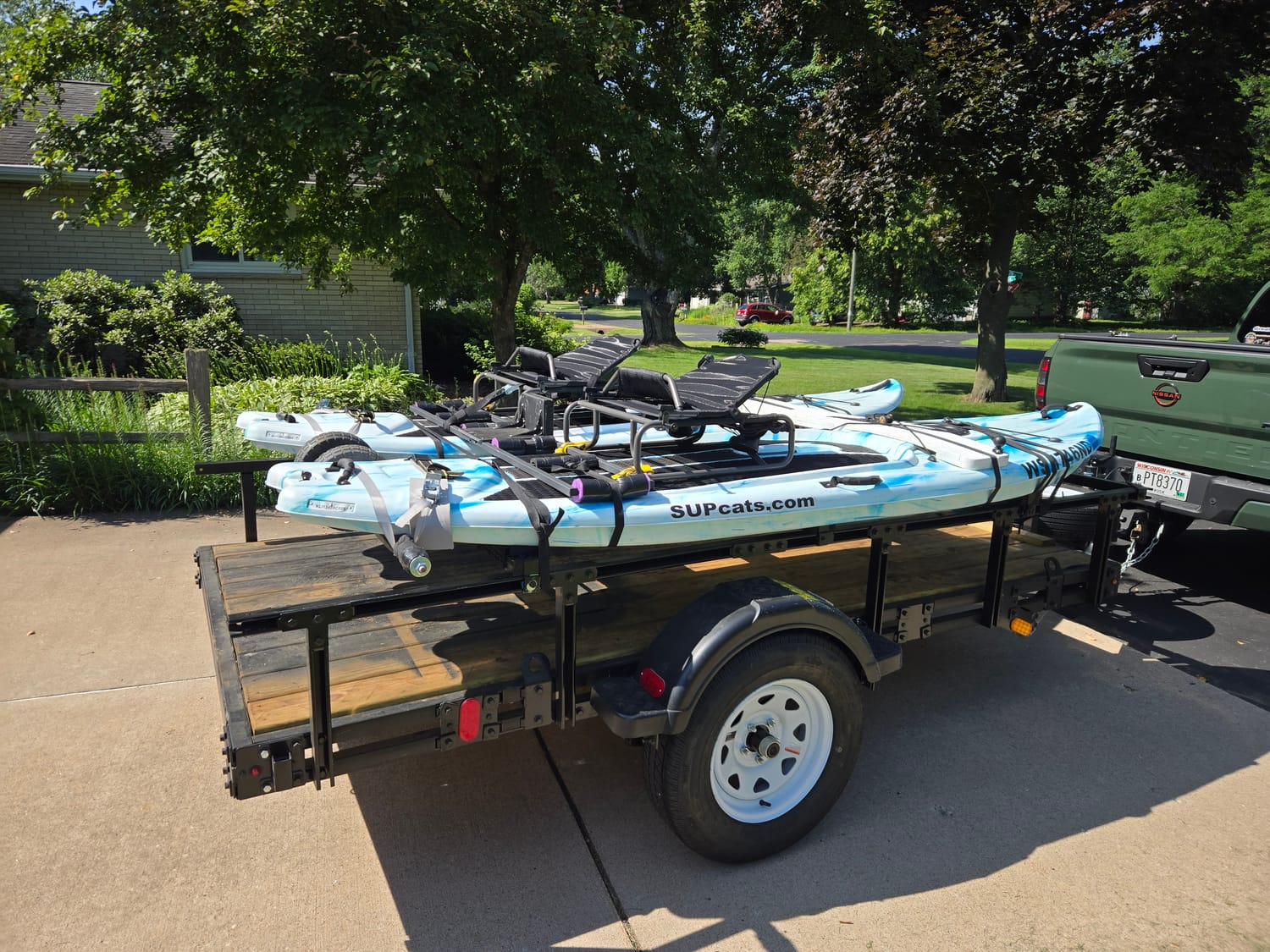
The SUP Cat on my utility trailer - just add motor and battery!
Please follow The Great Out There on Facebook and Instagram, Pinterest and YouTube - then leave your comments. Share with your friends. Subscribe for guaranteed access to future Great Out There content!!!

Recent Posts